Friday, March 2, 2012

Where does a girl like that come from?

Many readers asked me about Anita, the girl in the midst of a firestorm of passion in my book, My Own Voice. She is so different... How, some of you have wondered out loud, did she spring from your mind?

The answer is, at first I decided to model her as the-opposite-of-me. By which I mean a lot more that just her use of language (talking in sentences laden with 'like' and the dreaded double-negatives.) Anita was to become a bold and spontaneous spirit, anything but repressed. She would be promiscuous. Her voice would be shockingly direct:


"In my defense I have this to say: When men notice me, when the lusty glint appears in their eyes, which betrays how, in their heads, they’re stripping me naked—it’s me they accuse of being indecent. 
Problem is, men notice me all the time.
How can a girl like me ever claim to be innocent? Even if I haven’t done nothing wrong, I’m already soiled, simply because of their dirty thoughts." 

From the beginning she would move quickly to get what she wants:

"The minute our eyes met, I knew what to do: so I stopped in the middle of what I was doing, which was dusting off the glass shield over the ice cream buckets, and stacking up waffle cones here and sugar cones there. From the counter I grabbed a bunch of paper tissues, and bent all the way down, like, to pick something from the floor. Then with a swift, discrete shove, I stuffed the tissues into one side of my bra, then the other, ‘cause I truly believe in having them two scoops—if you know what I mean—roundly and firmly in place. 
Having a small chest is no good: men seem to like girls with boobs that bulge out."

She would do what I would not admit to even dream about doing:

So I asked, “So? What kind of cone for you?” but that woman cut in, ‘cause I was still holding her three-scoops tower of pistachio nut on a sugar cone. And she started to cry out, and like, demand some attention here, because hey, she was first in line, and how about whipped cream? Or some of that shredded coconut? 
So I smiled at her, in my most cool and polite manner, and squeezed out a big dollop of whipped cream, which was awesome, ‘cause it calmed her down right away. 
And I scattered some of them coconut flakes all over—quite a heap—and went even further, adding a cherry on top. At last, I raised the thing to my lips, because at this point, it was starting to drip already.
Then, winking at him, I passed my tongue over the top, and all around the ice cream at the rim of the cone, filling my whole mouth and, just to look sexy, also licking the tips of my fingers. Then I came around the counter, swaying my hips real pretty, and steadying myself over the wobbly high heels. I came right up to him, and before he could guess what kind of trouble I had cooked up in my head, I kissed him—so sweet and so long—on his lips, to the shouts and outcries of the offended customer. 

I do not even know how it happened, but once Anita started talking in my mind—which she did for nearly a year—I started to like her more and more. I asked myself, how would she play against Ben, who is a complex character, hesitant, highly sophisticated? How would she play against Lenny, a would-be author who is so proud of his refined expressions, when her background is so different from his?

To my surprise, Anita ended up taking over not only the story, but also me.


★ Love reading? Treat yourself to a family saga ★

 "A feast for the armchair psychologist. 
Reveals insights that can touch and frighten each of us"

Thursday, March 1, 2012

When a Man Crosses a River

Years ago I heard this old saying, which goes, "When a man crosses a river, the man ends up not the same as he used to be, and so does the river."

To me it means that every journey changes you, which is true no matter whether you are a man, a woman, or as this saying goes, the road itself.

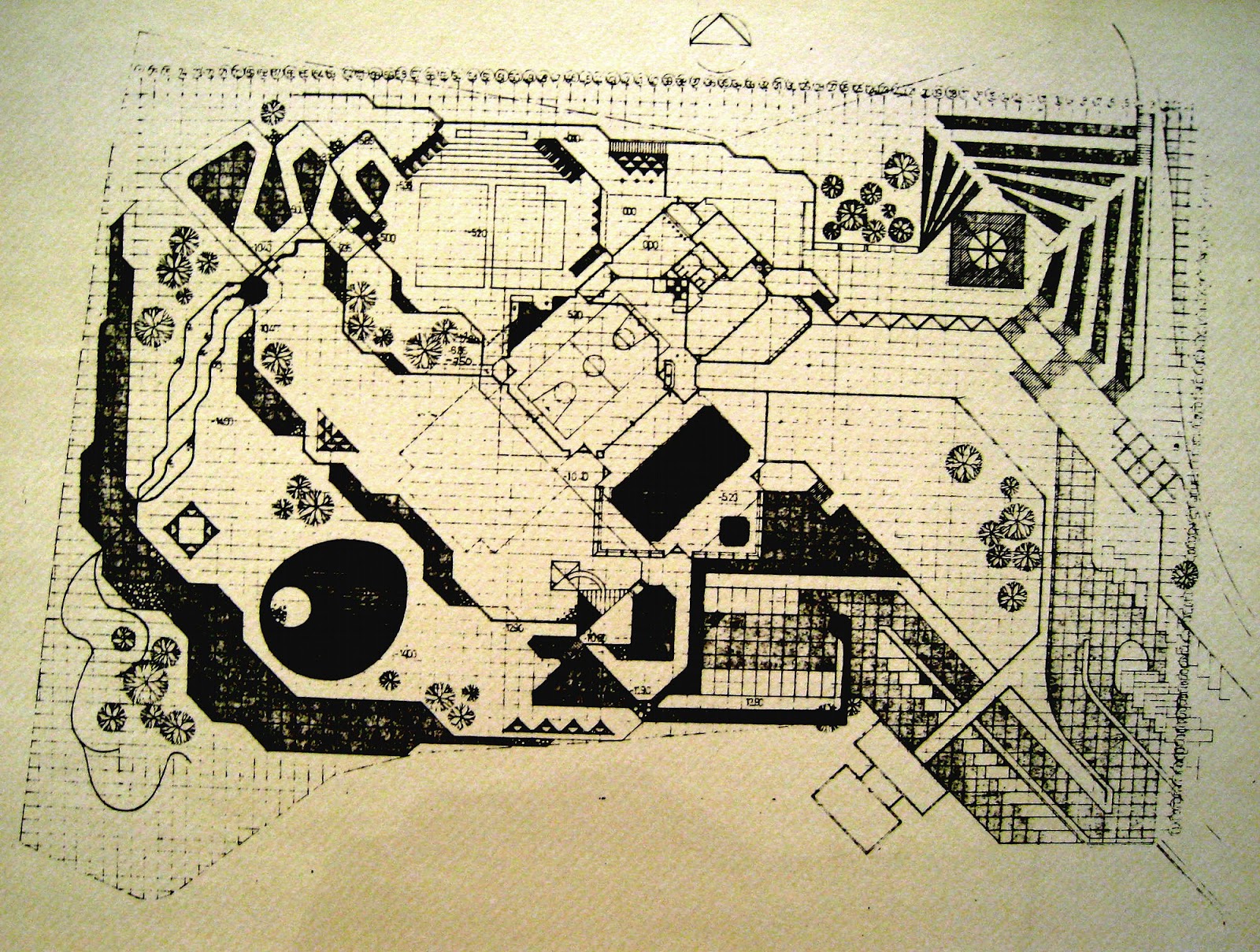
It was based on this idea that I designed the landscape of Beit Halochem, back in the days I worked as an architect. I gave a lot of thought to the person moving along every path across the site, what she sees, what changes around her with every step, how her mood is affected, how a transition occurs, a transition from the soaring lines of unusual geometry in the building, to an echo of this geometry in the land around it, to a faint echo, finally overcome by the softening, rounding hand of nature, around the far fringes of the site.

Here is a model of Beit Halochem, designed by the architect David Yanai:


And here are some freehand sketches of my vision for how it would sit against the slope of the Carmel mountain. This was my plan for the entire site:


And here, a few sketches of this and that spot in the site:


Tuesday, February 28, 2012

A chance is not something that is given. It is something you take.

My very first 'real' job was at T.O.A.M., a small architectural firm in Haifa, Israel. The work done in this firm was not part of the architectural mainstream. On the drawing board were the Israel Oceanographic and Limnological Research Institute, which "dabbles it feet in the water" (as architect Ram Karmi described it.)  Also, Beit Halohem (The Fighter's Home) which  exhibits "impressive virtuosity in geometric combinations" (as architect Abba Elhanani wrote of it.)

At the beginning of my four years at the firm—a period which coincided with my studies at the Technion—I was thrilled at the opportunity to learn. But after a while I started to feel uneasy with the limited responsibility I was given, designing various details, such as staircases, railings, and small spaces in Beit HaLochem. 


I went to my boss, the notoriously famous architect David Yanai, who at the time had exposed a corruption scandal in the construction of the project. The public fight which ensued meant that Beit Halochem was already doomed to remain on paper. I was young, and oblivious to this. All I wanted was to take a greater role in the design. I told him, "I want to be given a chance."

He replied—I will never forget it—"A chance is not something that is given. It is something you take."

Either way, I came out of that meeting with the chance I wanted: My new responsibility was to design the entire landscape around Beit Halochem, which was to be built on the side of the Carmel mountain, overlooking a breathtaking view of Haifa Bay.


In later years, when I came to visit the site, I saw the skeletal remains of the building, rusting there among the rocks on the steep slope, which is overgrown with thorny, wild weeds. Still, I see in my minds eye is papers upon papers of my landscape design, still rustling there, waiting. And all I can hear are those words, "A chance is not something that is given. It is something you take."

Tuesday, February 21, 2012

Ropes, Separation, Tear (Hebrew Edition) Now Available on Amazon

This is a must have book for readers of Hebrew Poetry. I am intimately familiar with the work the poet created in the prime of his life. I can recite some of his poems from memory. They were beautiful, deeply felt, but flowery. The poems in this last collection are vastly different.

Click to look inside:


Saturday, February 11, 2012

The Seed of the Story

Over a year ago I wrote a short story about a twelve years old boy coming face to face, for the first time in his life, with the sad spectacle of death in the family. The title of the story is Only An Empty Dress. In it, Ben watches his father  trying to revive his frail grandma, and later he attempts the same technique on the fish tilting upside down in his new aquarium.
 “I cannot allow myself to weep. No, not now. So I wipe the corner of my eye. Now if you watch closely, right here, you can see that the tail is still crinkling. I gasp, and blow again. I blow and blow, and with a last-gasp effort I go on blowing until all is lost, until I don’t care anymore, I mean it, I don’t care but the tears, the tears come, they are starting to flow, and there is nothing, nothing more I can do—”

I set the story aside, thinking I was done with it. But the character of the boy, Ben, came back to me and started chatting, chatting, chatting in my head. It became the seed of my just-published novel Apart from Love. 

In writing it I asked myself, what if I ‘aged’ him by fifteen years? Where would he be then? Would he still admire his father as a hero, or will he be disillusioned at that point? What secrets would come to light in the life of this family? How would it feel for Ben to come back to his childhood home, and have his memories play tricks on him? What if I introduce a girl, Anita, a redhead who looks as beautiful as his mother used to be, but is extremely different from her in all other respects? And what if this girl were married to his father? What if the father were an author, attempting to capture the thoughts, the voices of Ben and Anita, in order to write his book? 

So the process of writing became, for me, simply listening to the characters and trying, as fast as I could, to capture their thoughts. My role as an author was merely suggesting a place, coming up with the stage set and illuminating it as appropriate for the time of day, and allowing the characters to describe what they see and to act out their passions and fears. 

Wednesday, February 8, 2012

For Authors and Readers

Here is an excellent article, especially if you are a would be best-seller author in your heart of hearts.. Tells you about Amazon’s Top Reviewers, how crucial it is to find the ones who are passionate about your genre of writing. 
It is called Get your book reviewed on Amazon and boost your sales. 

__________________________________________

To hear the radio interview about my published work click here.